Ignaz Semmelweis
Hungarian doctor who proved hand washing reduced childbed fever.

OTFW , Berlin · CC BY-SA 3.0
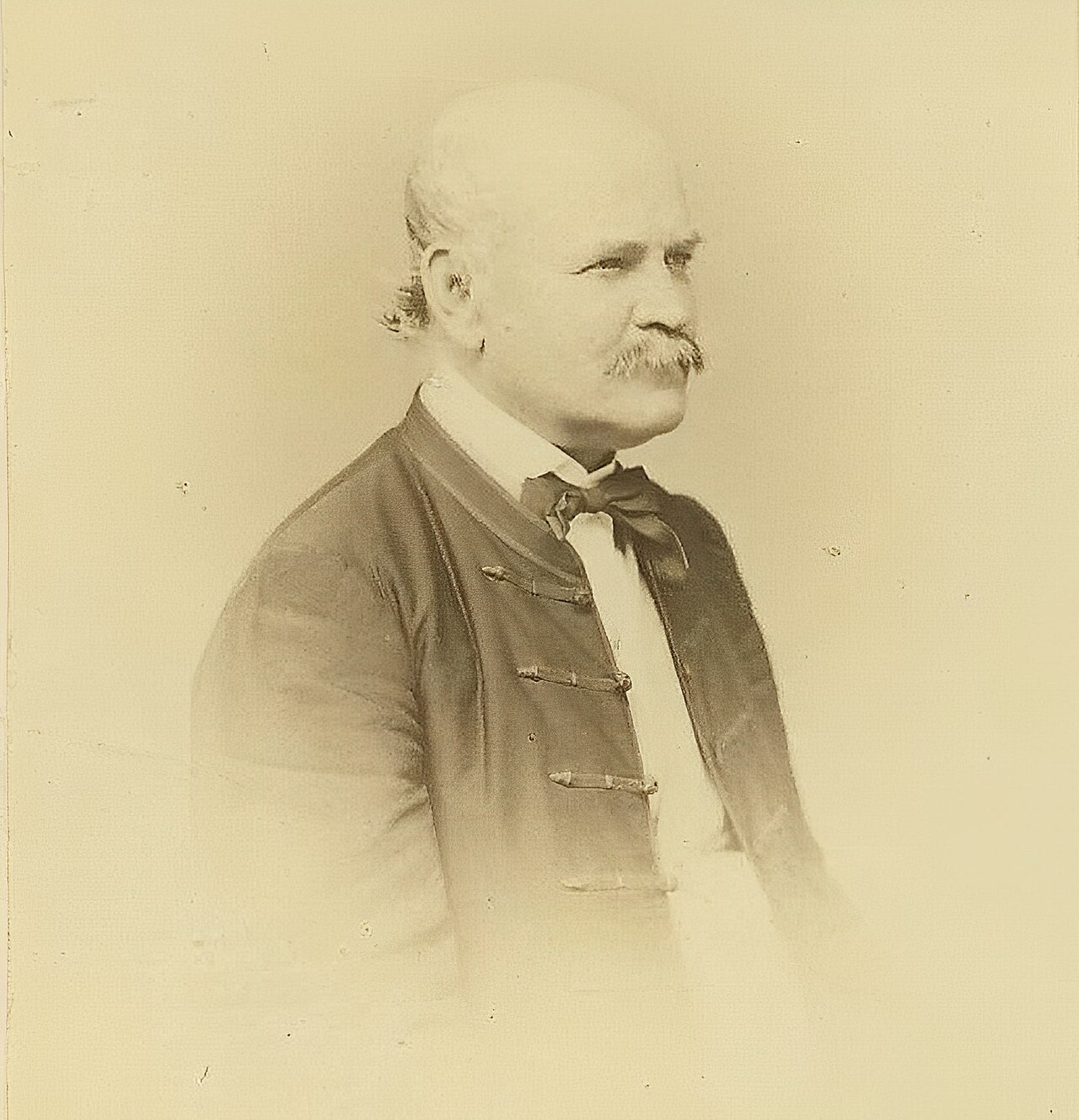
Ignaz Philipp Semmelweis was a Hungarian medical doctor and scientist of German descent who was an early pioneer of antiseptic procedures, known as the "saviour of mothers". He demonstrated that requiring healthcare workers in obstetrical clinics to disinfect their hands with chlorinated lime solutions drastically reduced the incidence of puerperal fever. In 1847, at Vienna General Hospital's First Obstetrical Clinic, his hand-washing protocol dropped maternal mortality from 18% to less than 2%. He published his findings in the 1861 book *Etiology, Concept and Prophylaxis of Childbed Fever*. Despite his results, his ideas were rejected by the medical community, and he died in 1865 after being committed to an asylum.
- born
- 1 July 1818
- died
- 13 August 1865
- field
- Medicine, obstetrics
- nationality
- Hungarian of German descent
- known_for
- Pioneering antiseptic hand washing to prevent puerperal fever
Verified Timeline
Lore & Background
Ignaz Semmelweis was born on 1 July 1818 in the Tabán neighbourhood of Buda, Kingdom of Hungary, Austrian Empire. He was the fifth child out of 10 of the prosperous grocer family of József Semmelweis and Teréz Müller. Of German ancestry, his father was an ethnic German born in Kismarton (now Eisenstadt, Austria), and his mother an ethnic German from Buda. Ignaz began studying law at the University of Vienna in the autumn of 1837, but switched to medicine. He was awarded his doctor of medicine degree in 1844. After failing to obtain an appointment in a clinic for internal medicine, Semmelweis specialized in obstetrics. On 1 July 1846, Semmelweis was appointed assistant to Professor Johann Klein in the First Obstetrical Clinic of the Vienna General Hospital. The First Clinic had an average maternal mortality rate of about 10% due to puerperal fever, while the Second Clinic's rate averaged less than 4%. Women begged on their knees not to be admitted to the First Clinic, and some gave birth in the streets to avoid it. Semmelweis's breakthrough came in 1847 after his friend Jakob Kolletschka died from a scalpel wound during an autopsy; Kolletschka's autopsy showed a pathology similar to that of women dying from puerperal fever. Semmelweis proposed that he and medical students carried "cadaverous particles" on their hands from autopsies to patients. He instituted hand washing with chlorinated lime solution, and the mortality rate in the First Clinic dropped from 18.3% in April 1847 to 2.2% in June, 1.2% in July, and 1.9% in August. In two months in the following year, the death rate was zero. Despite these results, Semmelweis's observations conflicted with established scientific views, and his ideas were rejected. Some doctors were offended by the suggestion that they should wash their hands. He was dismissed from the hospital for political reasons and moved to Budapest. In 1861, he published *Etiology, Concept and Prophylaxis of Childbed Fever*. His increasingly angry letters denouncing colleagues as irresponsible murderers led to him being committed to the Landesirrenanstalt Döbling in 1865. He died 14 days later from a gangrenous wound on his right hand, possibly from being beaten by guards. His findings gained widespread acceptance after Louis Pasteur confirmed the germ theory and Joseph Lister pioneered antiseptic methods.
Reader's Guide
Semmelweis's key discovery was that hand washing with chlorinated lime solution between autopsy work and patient examinations drastically reduced puerperal fever mortality. In April 1847, before the new procedures, the mortality rate at the First Obstetrical Clinic was 18.3%. After implementation in mid-May, rates fell to 2.2% in June, 1.2% in July, and 1.9% in August. For the first time since anatomical orientation was introduced, the death rate reached zero in two months of the following year. Semmelweis concluded that "cadaverous particles" transmitted from autopsies to patients caused the disease, though the germ theory was not yet accepted. His findings conflicted with established medical opinions, including the theory of dyscrasia (imbalance of four humours) and the belief that each disease case was unique. Autopsy findings showed a confusing multitude of physical signs, leading to the assumption that puerperal fever was many different diseases. Some doctors were offended at the suggestion that they should wash their hands, feeling their social status as gentlemen was inconsistent with the idea that their hands could be unclean. Semmelweis could not offer a theoretical explanation for his findings, which only became possible in the 1860s and 1870s with Pasteur, Lister, and Koch's work on germ theory. During 1848, he widened his washing protocol to include all instruments coming in contact with patients in labour, and used mortality time series to document his success in virtually eliminating puerperal fever from the ward.
Did You Know?
- Semmelweis was the fifth child out of 10 in a prosperous grocer family; his father's wholesale business was named 'Zum weißen Elefanten' (At the White Elephant).
- He began studying law at the University of Vienna in autumn 1837 before switching to medicine, earning his doctor of medicine degree in 1844.
- The mortality rate in the First Obstetrical Clinic dropped from 18.3% in April 1847 to 2.2% in June 1847 after he instituted hand washing with chlorinated lime.
- In two months of the year following his discovery, the death rate from puerperal fever was zero for the first time since anatomical orientation was introduced.
- Semmelweis died 14 days after being committed to an asylum, from a gangrenous wound on his right hand that may have been caused by being beaten by guards.
Roots in Buda and the Road to Medicine
Ignaz Semmelweis entered the world on 1 July 1818 in the Tabán district of Buda, then part of the Kingdom of Hungary within the Austrian Empire. He was the fifth of ten children born to József Semmelweis, an ethnic German originally from Kismarton (present-day Eisenstadt, Austria), and Teréz Müller, an ethnic German native of Buda. His father had been granted Buda citizenship in 1806 and that same year launched a wholesale spice and general-goods business called Zum weißen Elefanten, housed in the Meindl House on what is now Apród Street in Budapest. By 1810 the family was comfortably wealthy, and József married Teréz, daughter of the coachbuilder Fülöp Müller. In the autumn of 1837, young Ignaz enrolled at the University of Vienna to study law, but soon switched his focus to medicine. He earned his doctor of medicine degree in 1844, studying under prominent figures including Carl von Rokitansky, Joseph Škoda, and Ferdinand von Hebra. After failing to secure a position in an internal medicine clinic, he turned to obstetrics—a specialization that would ultimately define his life's work and, tragically, his fate.
The Two Clinics and the Question of Death
In the summer of 1846, a twenty-eight-year-old Hungarian physician took up an assistant post under Professor Johann Klein at the First Obstetrical Clinic of the Vienna General Hospital. What he found there would consume the rest of his career. The hospital housed two maternity wards side by side, yet their fates were starkly different: the First Clinic, staffed by doctors and medical students, recorded a maternal mortality rate hovering around ten percent from puerperal fever, while the Second Clinic, attended by midwives, kept that figure below four percent. The disparity was so notorious that women would kneel and beg not to be assigned to the First ward, and some even feigned labor in the streets to avoid admission there entirely. Semmelweis was haunted by this contradiction. He systematically ruled out overcrowding, since the Second Clinic was in fact more densely packed, and dismissed climate, given the two wards sat in close proximity. He even experimented with changing the birthing position and speculated that the sight of priests administering last rites might terrify mothers into developing fever. None of these explanations held, and the mystery deepened.
The Cadaverous Particle Hypothesis and the Chlorine Solution
The turning point arrived in 1847, when Semmelweis's close friend Jakob Kolletschka died after being accidentally cut by a student's scalpel during a post-mortem examination. The autopsy revealed a pathology strikingly similar to that seen in women succumbing to childbed fever. Semmelweis seized on this parallel and formulated what he called the cadaverous poisoning theory: doctors and medical students in the First Clinic were unknowingly transferring invisible cadaverous particles from the autopsy room onto the hands they used to examine laboring patients. The midwives in the Second Clinic, who never handled corpses, had no such contamination, which accounted for their far lower death rates. Because the germ theory of disease had not yet taken hold in Viennese medicine, Semmelweis could not name the actual microorganisms at work. He reasoned that the chlorinated lime solution he used to mask the putrid odor of infected autopsy tissue might also destroy whatever poisonous agent was being carried. He mandated that all hands be washed in this calcium hypochlorite solution between post-mortem work and patient contact. The effect was dramatic: the First Clinic's mortality plummeted from 18.3 percent in April 1847 to 2.2 percent in June, 1.2 percent in July, and 1.9 percent in August, bringing it in line with the midwives' ward for the first time.
Rejection, Asylum, and Posthumous Vindication
Despite the compelling statistics, Semmelweis's ideas collided with the prevailing scientific orthodoxy of mid-nineteenth-century medicine. He could not supply a theoretical framework explaining why handwashing reduced deaths, and many physicians took personal offense at the implication that their own hands were vectors of death. Rather than embrace his findings, colleagues mocked him and dismissed his work. His growing frustration made him increasingly outspoken, deepening the hostility around him. By 1865, he purportedly suffered a nervous breakdown and was committed to an asylum by his fellow doctors. While confined, he was beaten by the guards. Fourteen days after admission, he died from a gangrenous wound on his right hand that may have been caused by that beating. His 1861 book, Etiology, Concept and Prophylaxis of Childbed Fever, had failed to win over the establishment during his lifetime. It would take Louis Pasteur's confirmation of germ theory and Joseph Lister's antiseptic surgical methods to provide the scientific language that vindicated Semmelweis's observations and secured his legacy as a foundational figure in antiseptic medicine.
Gallery
Frequently Asked Questions
Who is Ignaz Semmelweis?
Ignaz Semmelweis was a Hungarian physician of German heritage, born in 1818, who became one of the earliest champions of antiseptic practice in medicine. He worked primarily in obstetrics and is remembered for his groundbreaking work on preventing infection in maternity wards.
What did Ignaz Semmelweis discover?
He showed that requiring physicians to scrub their hands with a chlorinated lime solution before examining patients caused a sharp drop in cases of puerperal fever. This simple but revolutionary observation laid the groundwork for modern antiseptic technique.
Why is Ignaz Semmelweis called the 'saviour of mothers'?
The nickname reflects the fact that his hand-washing protocol saved the lives of countless women who would otherwise have succumbed to postpartum infection. Before his intervention, childbed fever was a leading cause of maternal death in hospital settings.
How did Ignaz Semmelweis's story end?
Despite his vital contribution, Semmelweis died in 1865 without receiving the recognition he deserved from the broader medical world. In his final years he was confined to an asylum, and he passed away largely unappreciated by the very profession he had tried to reform.
Why was Ignaz Semmelweis rejected by the medical community?
His claim that doctors' own hands were vectors of infection struck many colleagues as an insult, since prevailing theory blamed miasmas or other external causes. The combination of professional pride and entrenched dogma led to widespread ridicule and marginalization of his findings.
More in Pioneers Of Medicine 1-24
Elsewhere in the Pioneers Of Medicine universe
Spotted an error? Know more?
This is a living reference — every entry is fact-audited, and reader corrections feed straight into our audit queue. Suggest an edit · See this site's audit record